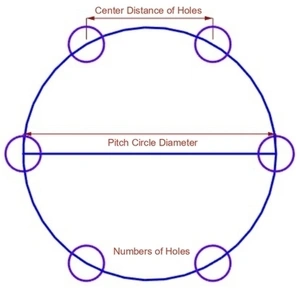
How Center Distance Between Holes Is Calculated
Center distance between holes is an important measurement in machining and fabrication. It is the straight-line spacing used when holes must be evenly positioned around a circular pattern or across a part. Accurate spacing helps ensure the finished component fits and functions correctly.
In drilling operations, the pitch circle diameter and the number of holes are used to determine the distance between adjacent hole centers. This is commonly required for bolt circles, round flanges, indexing plates, and machine parts that must be drilled in equal divisions.
Why Hole Spacing Matters
Formula Explanation
For equally spaced holes around a circular pattern, the hole spacing is based on the pitch circle diameter and the number of holes.
Basic idea: divide the circle into equal parts, then use that division to find the center distance between neighboring holes.
Common layout formula:
Chord length between adjacent holes = 2 × R × sin(180° ÷ Number of Holes)
Where R is the pitch circle radius, and the chord length gives the center-to-center spacing between neighboring holes on the circle.
Example Calculation
Suppose you need to drill 6 holes on a pitch circle diameter of 120 mm.
Radius = 120 ÷ 2 = 60 mm
Chord spacing = 2 × 60 × sin(180° ÷ 6)
Chord spacing = 120 × sin(30°)
Chord spacing = 120 × 0.5 = 60 mm
So the center distance between adjacent holes is 60 mm.