 Engineer
Introduction
Bearings are the unsung heroes of mechanical engineering. These precision components enable smooth rotation, reduce friction, and support loads in virtually every machine — from tiny electric motors to massive industrial gearboxes. Understanding the different types of bearings and their applications is essential for design engineers, maintenance professionals, and machinists alike.
This comprehensive guide covers the eight most common bearing types used in industry: Deep Groove Ball Bearings, Double Row Deep Groove Ball Bearings, Tapered Roller Bearings, Thrust Ball Bearings, Cylindrical Roller Bearings, Double-Row Cylindrical Roller Bearings, Self-Aligning Ball Bearings, and Spherical Roller Bearings. We also explain the bearing numbering system so you can identify bearing size and specifications from its designation.
What is a Bearing?
A bearing is a machine element that constrains relative motion between two parts to only the desired motion (typically rotation or linear movement) while reducing friction between them. Bearings support loads, guide moving parts, and transmit forces from one component to another.
The fundamental principle of a bearing is to replace sliding friction with rolling friction (in rolling-element bearings) or to use a fluid film (in fluid bearings). Rolling-element bearings use balls, rollers, or needles as the rolling elements.
Key components of a rolling bearing:
- Inner ring (inner race): Fits onto the shaft.
- Outer ring (outer race): Fits into the housing.
- Rolling elements: Balls or rollers that carry the load.
- Cage (retainer): Separates and guides the rolling elements.
Why are Bearings Important?
Bearings are critical to modern machinery for several reasons:
- Reduce friction: Minimize energy loss and heat generation.
- Support loads: Carry radial, axial, or combined loads.
- Enable precision motion: Allow accurate positioning and rotation.
- Extend equipment life: Proper bearing selection increases machine longevity.
- Reduce maintenance: Reliable bearings minimize downtime.
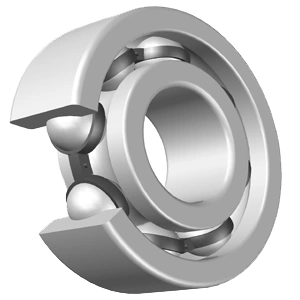 Deep Groove Ball Bearing
Deep Groove Ball Bearing
⚫ Deep Groove Ball Bearing Most Common
Description: The deep groove ball bearing is the most widely used type of rolling bearing. It features deep, uninterrupted raceway grooves on both the inner and outer rings, allowing it to handle both radial and moderate axial loads in both directions.
Characteristics:
- Simple design, robust, and low maintenance.
- Can accommodate radial and axial loads (up to about 30% of radial load capacity).
- Available in single-row and double-row configurations.
- Low friction and high-speed capability.
- Sealed or shielded versions available for contamination protection.
Applications: Electric motors, pumps, gearboxes, conveyors, automotive wheels, household appliances, and general machinery.
Common series: 6000, 6200, 6300, 6400 series (metric). 1600, 6200 series (inch).
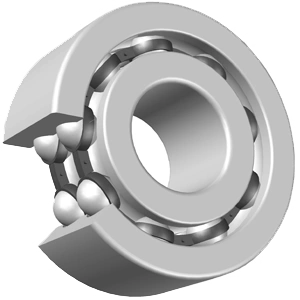 Double Row Deep Groove Ball Bearing
Double Row Deep Groove Ball Bearing
⚫⚫ Double Row Deep Groove Ball Bearing Higher Load
Description: This bearing has two rows of balls in a single unit, providing approximately double the radial load capacity of a single-row bearing. It can also handle higher axial loads in both directions.
Characteristics:
- Higher load capacity than single-row equivalent.
- Less axial displacement capability than single-row.
- More rigid than single-row designs.
- Available in sealed or open versions.
Applications: Gearboxes, electric motors with higher loads, pumps, industrial fans, and automotive transmissions.
Common designation: 42xx, 43xx series (e.g., 4206, 4308). Also designated with "D" or "DD" suffix in some manufacturers.
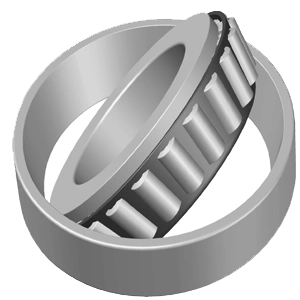 Tapered Roller Bearing
Tapered Roller Bearing
🔺 Tapered Roller Bearing Heavy Duty
Description: Tapered roller bearings use conical rollers and raceways, allowing them to support high radial and axial loads simultaneously. The rollers are tapered so the apex of the cone meets at a common point on the bearing axis.
Characteristics:
- Designed to handle combined (radial + axial) loads.
- High load capacity relative to size.
- Can be adjusted for preload or clearance.
- Usually mounted in pairs (opposed) to handle thrust in both directions.
- Separable design allows for easy assembly and maintenance.
Applications: Automotive wheel hubs, gearboxes, axles, construction equipment, rolling mills, and heavy machinery.
Common designation: 302xx, 303xx, 322xx, 323xx series (metric). Inch series: LM, L, etc.
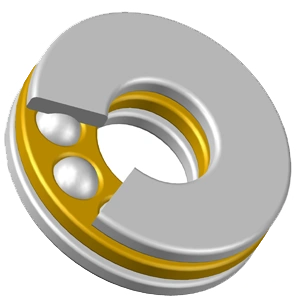 Thrust Ball Bearing
Thrust Ball Bearing
⬆ Thrust Ball Bearing Axial Load
Description: Thrust ball bearings are designed to handle pure axial loads (thrust). They consist of a shaft washer, a housing washer, and a ball and cage assembly. They cannot support radial loads.
Characteristics:
- Designed for axial loads only — no radial load capacity.
- Available in single-direction and double-direction types.
- Low friction and good high-speed capability.
- Simple design and cost-effective.
- Often used in applications with low to moderate thrust loads.
Applications: Gearbox thrust washers, automotive transmissions, clutch release mechanisms, machine tool spindles, and crane hooks.
Common designation: 511xx, 512xx, 513xx series (metric). Also designated as "T" or "TH" prefix.
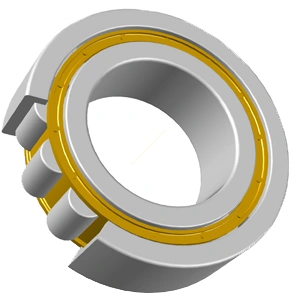 Cylindrical Roller Bearing
Cylindrical Roller Bearing
▬ Cylindrical Roller Bearing High Radial
Description: Cylindrical roller bearings use cylindrical rollers instead of balls, providing high radial load capacity. The rollers have a line contact with the raceways, distributing the load over a larger area.
Characteristics:
- Very high radial load capacity.
- Limited axial load capacity (depending on design).
- Low friction and good high-speed capability.
- Ribs on the rings guide the rollers.
- Often separable (inner ring can be removed independently).
Applications: Electric motors, gearboxes, pumps, rolling mills, paper machines, and general industrial machinery.
Common designation: NU, NJ, NUP, N, NF series (e.g., NU210, NJ306). Also designated as "C" or "E" series.
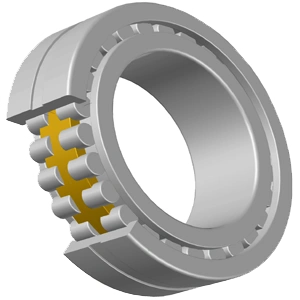 Double-Row Cylindrical Roller Bearing
Double-Row Cylindrical Roller Bearing
▬▬ Double-Row Cylindrical Roller Max Radial
Description: This bearing has two rows of cylindrical rollers, providing exceptionally high radial load capacity in a compact design. It is ideal for applications with very heavy radial loads and limited space.
Characteristics:
- Very high radial load capacity (double that of single-row).
- Limited axial load capacity.
- High rigidity.
- Often used in rolling mills and heavy machinery.
- Available with or without ribs for axial guidance.
Applications: Rolling mills, heavy gearboxes, paper machine rollers, and large industrial fans.
Common designation: NNU, NN, NNCF, NNC series (e.g., NNU4920, NN3020).
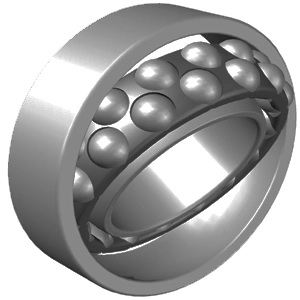 Self-Aligning Ball Bearing
Self-Aligning Ball Bearing
⚪ Self-Aligning Ball Bearing Misalignment
Description: Self-aligning ball bearings have two rows of balls with a common spherical raceway in the outer ring. This design allows the bearing to accommodate angular misalignment of the shaft relative to the housing.
Characteristics:
- Accommodates angular misalignment (up to 2°–3°).
- Good radial load capacity.
- Moderate axial load capacity in both directions.
- Self-aligning capability reduces stress on the bearing.
- Used where shaft deflection or mounting errors may occur.
Applications: Agricultural equipment, conveyor systems, textile machinery, paper machines, and fans with long shafts.
Common designation: 12xx, 13xx, 22xx, 23xx series (e.g., 1206, 2308).
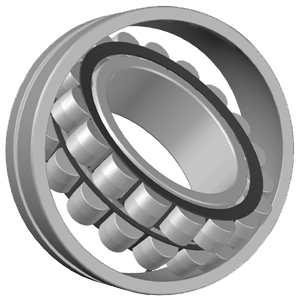 Spherical Roller Bearing
Spherical Roller Bearing
🔘 Spherical Roller Bearing Extreme Duty
Description: Spherical roller bearings are the heavy-duty champions of the bearing world. They have spherical rollers (barrel-shaped) that run on spherical raceways in the outer ring, providing self-alignment and extremely high load capacity.
Characteristics:
- Very high radial load capacity.
- High axial load capacity in both directions.
- Self-aligning (accommodates misalignment up to 2°).
- Excellent shock and vibration resistance.
- Available in sealed, shielded, or open versions.
Applications: Heavy gearboxes, rolling mills, crushers, vibratory screens, paper machines, and marine propulsion systems.
Common designation: 222xx, 223xx, 230xx, 231xx, 232xx series (e.g., 22208, 22312).
How to Find Bearing Size by Number (Bearing Designation System)
Most rolling bearings use a standardized numbering system (ISO 15 or DIN 623) that encodes the bearing's type, size, and features. Understanding this system allows you to identify a bearing's specifications from its designation.
| Position | Meaning | Example (6205) |
|---|---|---|
| First digit | Bearing type or series | 6 = Deep groove ball bearing |
| Second digit | Diameter series (width/height series) | 2 = Light series (medium width) |
| Last two digits | Bore diameter (×5 for metric) | 05 = 5 × 5 = 25 mm bore |
| Prefix (optional) | Manufacturer-specific or design variations | — |
| Suffix (optional) | Seals, shields, clearance, cage type, etc. | 2RS = two rubber seals |
Understanding the Basic Number
The basic bearing number typically consists of 3 to 5 digits. Here's how to decode it:
- Bore diameter: The last two digits multiplied by 5 gives the bore diameter in mm (for bearings with bore ≥ 10 mm). For example, "05" = 25 mm, "10" = 50 mm, "15" = 75 mm.
- Diameter series: The second digit (or sometimes the first and second together) indicates the outer diameter and width series. Common series: 0 (extra light), 1 (extra light), 2 (light), 3 (medium), 4 (heavy).
- Bearing type: The first digit indicates the bearing type: 6 = deep groove ball, 7 = angular contact, 3 = tapered roller, 2 = spherical roller, etc.
6205 → 6 = deep groove ball, 2 = light series, 05 = 25 mm bore.
6308 → 6 = deep groove ball, 3 = medium series, 08 = 40 mm bore.
NU210 → NU = cylindrical roller (inner ring removable), 2 = light series, 10 = 50 mm bore.
22212 → 2 = spherical roller, 22 = diameter series, 12 = 60 mm bore.
51106 → 5 = thrust ball, 1 = series, 06 = 30 mm bore.
Common Suffix Codes
| Suffix | Meaning |
|---|---|
| 2RS | Two rubber seals (contact seals) |
| 2Z | Two metal shields (non-contact) |
| RS | One rubber seal |
| Z | One metal shield |
| NR | Snap ring groove in outer ring |
| C3 | Increased internal clearance |
| C4 | Large internal clearance |
| P5 | Precision class 5 (higher accuracy) |
| P6 | Precision class 6 |
| M | Machined brass cage |
| TN | Nylon cage |
🔧 Interactive Bearing Number Decoder
Enter a bearing number (e.g., 6205, 6308, NU210, 22212, 51106) and click decode to see the specifications.
📐 Bearing Number Decoder
Bearing Manufacturing Process Overview
- Material selection: High-quality bearing steel (e.g., 52100, SAE 52100) or stainless steel for corrosion resistance.
- Forging: Rings are forged from steel bars or tubes.
- Annealing: Softens the material for machining.
- Turning: Rough machining of the rings.
- Heat treatment: Hardening and tempering to achieve the required hardness (typically 58–65 HRC).
- Grinding: Precision grinding of the raceways and surfaces to final dimensions and surface finish.
- Rolling elements: Manufactured separately (balls or rollers) through cold heading, grinding, and lapping.
- Assembly: Assembly of the rings, rolling elements, and cage.
- Inspection: Dimensional, noise, and torque testing.
- Lubrication and packaging: Grease or oil applied, then packaged for delivery.
Application Summary by Bearing Type
| Bearing Type | Primary Load | Typical Applications |
|---|---|---|
| Deep Groove Ball | Radial + light axial | Motors, pumps, conveyors, appliances |
| Double Row Deep Groove | Radial + moderate axial | Gearboxes, industrial fans |
| Tapered Roller | Combined (radial+axial) | Wheel hubs, gearboxes, axles |
| Thrust Ball | Axial only | Clutches, gearbox thrust, crane hooks |
| Cylindrical Roller | High radial | Motors, gearboxes, rolling mills |
| Double-Row Cylindrical | Very high radial | Rolling mills, heavy gearboxes |
| Self-Aligning Ball | Radial + misalignment | Conveyors, agricultural, textile |
| Spherical Roller | Very high combined | Heavy gearboxes, crushers, paper machines |
Advantages & Limitations of Rolling Element Bearings
Advantages
- Low starting friction and running friction.
- High load-carrying capacity relative to size.
- Precision and repeatability.
- Wide range of types and sizes available.
- Relatively low maintenance.
- Interchangeability across manufacturers.
Limitations
- Limited life due to fatigue (L10 life).
- Sensitive to contamination and poor lubrication.
- Noise and vibration at high speeds.
- Cannot handle shock loads as well as fluid bearings.
- Can be damaged by improper mounting or handling.
Common Bearing Failure Causes
- Fatigue: Spalling or pitting of the raceways from cyclic loading.
- Wear: Abrasive wear from contamination or poor lubrication.
- Corrosion: Moisture ingress causing rust.
- Overheating: Excessive temperature causing lubricant breakdown.
- Misalignment: Uneven load distribution leading to premature failure.
- Improper mounting: Damage from hammer blows or incorrect press fits.
- Lubrication failure: Insufficient or degraded lubricant.
Bearing Maintenance Tips
- Proper lubrication: Use the correct type and quantity of grease or oil.
- Monitor temperature: Sudden temperature rise indicates a problem.
- Listen for noise: Unusual sounds often indicate wear or damage.
- Vibration analysis: Regular monitoring can predict failure.
- Keep clean: Prevent contamination during handling and mounting.
- Use proper tools: Never hammer on bearings; use press or induction heater for mounting.
Safety Considerations
- Lockout/tagout: Ensure machinery is isolated before bearing maintenance.
- Use proper lifting equipment: For large bearings.
- Wear gloves and eye protection: When handling lubricants and cleaning solvents.
- Be aware of pinch points: When installing or removing bearings.
- Follow manufacturer procedures: For mounting and dismounting.
Industry Standards
- ISO 15: Radial bearings — Boundary dimensions, general plan.
- ISO 76: Static load ratings.
- ISO 281: Dynamic load ratings and rating life.
- DIN 623: Rolling bearings — Standard designation.
- ANSI/ABMA 20: Radial bearings — Boundary dimensions.
- Machinery's Handbook: Comprehensive bearing data tables.
Practical Workshop Tips for Bearings
- Store bearings horizontally: In their original packaging to prevent contamination.
- Use an induction heater: For mounting bearings with an interference fit (never use a torch).
- Check shaft and housing tolerances: Before installation.
- Apply a thin film of oil: To the shaft before mounting to reduce friction.
- Use a feeler gauge: To check internal clearance after mounting.
- Keep a bearing log: Record installation dates, operating conditions, and inspection results.
- When in doubt, consult the manufacturer's catalog: For specific installation guidelines.
Common Mistakes in Bearing Selection and Use
- Incorrect bearing type: Choosing a bearing that cannot handle the load or speed.
- Improper fit: Using the wrong shaft or housing tolerance.
- Over-lubrication: Too much grease can cause overheating.
- Under-lubrication: Not enough lubricant leads to premature wear.
- Mixing lubricants: Incompatible greases can break down.
- Ignoring contamination: Dirt and debris are the leading cause of bearing failure.
- Incorrect preload: Too much or too little preload affects bearing life.
- Misreading the bearing number: Leading to the wrong replacement bearing.
Frequently Asked Questions
Conclusion
Bearings are fundamental to mechanical engineering, enabling smooth, efficient motion in countless applications. Understanding the different types — from the versatile deep groove ball bearing to the heavy-duty spherical roller bearing — is essential for proper machine design, maintenance, and troubleshooting.
In this guide, we've covered the eight most common bearing types, their characteristics, applications, and advantages. We've also explained the bearing numbering system so you can quickly identify bearing size and specifications from its designation.
Remember to always select the right bearing for your application, follow proper mounting procedures, and maintain your bearings with the correct lubrication and monitoring. With the right knowledge and practices, bearings will provide reliable service for thousands of hours.
📌 Related resources from Engineer Data Hub:
- Bearing Identification Tool — Use our interactive decoder
- Spur Gear Calculator — Gear design and analysis
- Taper Calculator — For taper turning calculations
- Simple Indexing Calculator — For dividing heads
Bookmark this page for your next bearing selection or replacement project. Share it with your colleagues — and keep your machines running smoothly.